

Step-by-step scent matching guide
How to Find Perfume by Notes That Match Your Taste
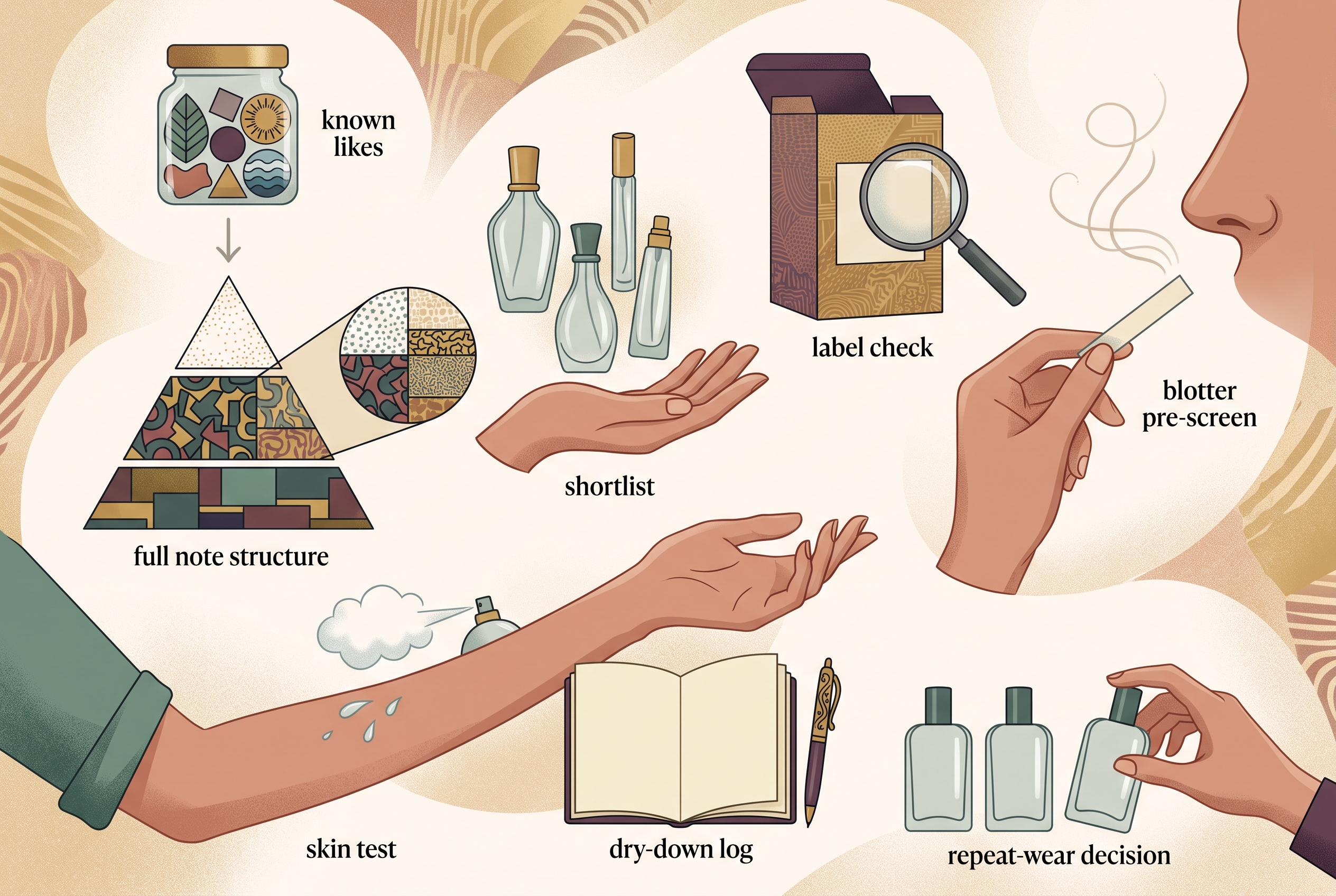
Short answer: Start with perfumes you have genuinely enjoyed and record the notes they share, the notes you avoid and when you liked wearing them. Use the complete note structure to build a small shortlist, then test one candidate at a time according to its label. Record the opening, middle, later dry-down and comfort. Choose only after a repeat wear, because matching one listed note does not guarantee a similar scent.
Notes are useful search filters, not ingredient quantities or promises. The same named note can appear differently beside citrus, florals, woods, spices, musks or sweet accords, and a written pyramid cannot reproduce smell on your skin. This workflow is deliberately different from a general perfume-notes explainer: it moves from evidence you already have to a controlled keep-or-pass decision.

Step 1 Record perfumes and notes you already know
Choose two or three fragrances you have worn enough to judge. For each one, write what you liked, what became tiring, the setting and the part of the wear you remember. Then copy the published note structure from the current brand or retailer page. Keep experience and marketing description in separate columns.
Look for repeated patterns rather than one “magic” ingredient. You may find that several favourites share a bright opening but differ in the later base, or that a note you thought you disliked worked well in one composition. Record uncertainty honestly. “I think I like woods, but only in soft compositions” is more useful than declaring that every woody scent will work.
If you cannot identify a proven favourite, begin with broad contrasts such as fresh versus warm, dry versus sweet, quiet versus noticeable, and everyday versus occasion wear. Auremie’s Find Your Scent route can organise those preferences, but its suggestions still require product-level review and testing.
Step 2 Read the entire note structure
A top, heart and base list describes a composition’s intended development, but it does not tell you the concentration of each material or exactly what you will perceive. Read all layers. A familiar top note may lead to a heart or base you do not enjoy, while a less-familiar opening may settle into a profile that fits.
Compare relationships: which notes support the one you like, which add sweetness or dryness, and which appear only in the opening. Do not treat similar note lists as duplicates. Order, balance, materials, concentration and perception can differ even when several words match.
Use Auremie’s existing perfume notes guide for terminology, then return to this decision workflow. The goal here is not to memorise categories; it is to form a testable reason for adding a candidate to the shortlist.
Step 3 Build a small candidate matrix
Open the current Auremie collection and verify each product rather than relying on an older article or search snippet. Record only the notes and product details currently published. This guide does not confirm which fragrances, notes, formats, prices or sizes are available.
| Candidate | Reason to test | Possible mismatch | Question to verify |
|---|---|---|---|
| A | Shares a proven note pattern | Different supporting accord | Is the current note list complete? |
| B | Fits the intended setting | Unfamiliar base direction | Is a sample currently offered? |
| C | Contrasts with the first two | May sit outside your usual style | What label directions apply? |
Keep the list small enough to compare clearly. Include one controlled wildcard rather than ten near-duplicates. If sampling formats are relevant, check the live discovery-set collection; do not assume a specific fragrance or quantity is included.
Step 4 Prepare a fair, label-directed test
Read the product label and directions before use. Health Canada’s cosmetics safety guidance includes perfume within cosmetics and advises consumers to read and follow directions. It also advises keeping spray cosmetics away from flames or heat.
Use a neutral setting without another strong fragrance competing for attention. A blotter can help screen an opening without placing every candidate on your skin, but it does not replace a wear decision. When proceeding to skin, follow the exact label, use only what is needed for comparison and avoid layering products during the test.
Prepare a simple log with the product name, current note list, application time, setting, opening impression, later impression, comfort and keep/pass decision. Do not borrow longevity claims from a review. Measure only your own experience under the conditions you record.
Step 5 Test the opening, transition and dry-down
Notice the opening without deciding immediately. Return later and describe what changed in plain language: brighter, softer, sweeter, drier, warmer, sharper or quieter. You do not need to identify every material. The key question is whether the complete progression fits the experience you wanted.
Compare one candidate against your proven favourite on different wear days, not by spraying many fragrances together. Keep the setting reasonably similar. If weather, clothing or activity differs, note it rather than treating the result as a controlled comparison.
Health Canada’s cosmetic labelling resource explains fragrance-ingredient labelling and notes that certain fragrance ingredients can cause allergic skin reactions in some people. Read the current ingredient label. If you have a known allergy or medical concern, seek appropriate professional advice rather than relying on a note pyramid.
Step 6 Repeat the finalists before a full purchase
A first wear can be influenced by novelty, setting and expectation. Repeat the strongest candidate on another suitable day and ask three questions: Did I enjoy the opening and later stages? Did it fit the intended setting? Would I choose to wear it again without being reminded?
Break a tie with use, not a larger note count. One finalist may fit everyday wear while another suits a specific occasion. The correct result can also be “neither.” A shortlist is allowed to end without a purchase.
Before ordering, recheck the product page, size or format, current price, stock, shipping and refund terms. Fragrance returns may be subject to product and condition rules; do not assume a sampled, opened or personalised item is eligible.
Stop conditions that protect the decision
- Stop the test and follow product directions if you experience irritation, discomfort or another adverse reaction.
- Stop comparing when strong background scents or nose fatigue make candidates indistinguishable; resume another day.
- Stop relying on a note list when the live product page or label is unclear; ask the seller.
- Stop before applying a fragrance that conflicts with a known sensitivity or professional advice.
- Stop the purchase if the desired product, sample inclusion, price, shipping or return term cannot be verified.
A stop condition is not failure. It prevents an uncertain test from turning into a confident but unsupported conclusion.
Common note-matching mistakes
- Choosing by one favourite note while ignoring the supporting structure.
- Assuming two perfumes with similar notes will smell or last the same.
- Testing too many candidates together and losing the comparison.
- Judging only the opening instead of the later dry-down.
- Using reviews as proof of personal longevity or projection.
- Applying without reading the current label and directions.
- Buying a full format before repeating the wear test.
- Assuming an older article proves current inventory or price.
Frequently asked questions
Can I find perfume from one note I like?
You can start there, but compare the complete note structure and test the finished fragrance. One shared note does not establish a match.
Are top, heart and base notes ingredients?
They are an explanatory structure for how a fragrance is presented and may be perceived. They do not necessarily disclose quantities or every ingredient. Read the product label for current information.
Should I test on paper or skin?
Paper can pre-screen candidates. A skin test performed according to the label is more relevant to a personal wear decision, provided it is appropriate for you.
How long will an Auremie perfume last?
This guide does not verify longevity for any product. Check the current listing and test the exact fragrance under your own conditions.
Turn your note list into a testable shortlist
Write three proven likes, two dislikes and one intended setting, then use Auremie’s Find Your Scent and current collection pages to create a small shortlist. If a note list, sample inclusion, ingredient label, format or policy is unclear, use the contact page before buying. Let a repeat wear—not the number of matching words—make the final decision.
This is general fragrance-shopping information, not medical advice or a product-safety certification. Follow labels and seek professional guidance for allergies, sensitivities or other health concerns.