

A preference-first guide to women's fragrance
How to Choose a Feminine Perfume You Will Love
Short answer. Start with the feeling and setting you want, not a list of supposedly feminine notes. Narrow by scent family and intensity, read the current product and ingredient information, then compare a few finalists on blotter and skin on separate wears. Buy the fragrance you enjoy after the opening has changed—not the one with the most persuasive label.

Choose by the scent experience you want, then test the finalists in the situations where you would wear them.
Decide what feminine perfume means to you
Feminine is a retail and cultural description, not a technical scent family. One shopper may picture airy petals and clean musk; another may want dark fruit, woods, amber, leather or spice. A fragrance does not need to follow a gender rule to belong on your skin.
Use the label as a browsing doorway, then translate it into sensory words. Do you want soft or vivid, cool or warm, sheer or enveloping, polished or playful, familiar or surprising? Name the impression without naming a brand. This prevents a category label from making the decision for you.
Auremie currently separates For Women, Unisex, Discovery Sets and Sample Sets in its collection structure. Browsing more than one path can be useful if the note direction you want sits outside a conventional label. Current products, formats and availability must always be checked on the live pages.
Build a one-sentence perfume brief
A useful brief joins taste, context and boundaries. Try: “I want a bright floral-wood scent for daytime that stays close enough for shared spaces and avoids a note I know I dislike.” Or: “I want a warm, textured evening scent that feels special without becoming overly sweet to me.”
Include four decisions:
- Purpose: daily reach, work, evening, celebration, gift or exploration.
- Direction: fresh, floral, fruity, gourmand, woody, amber, aromatic, spicy, musky or a blend.
- Presence: quiet, moderate or statement-making to your perception.
- Boundaries: disliked notes, known sensitivities, budget, bottle size or shopping deadline.
A brief does not guarantee a match. It reduces an entire catalogue to a testable shortlist and gives a fragrance adviser something more useful than “something feminine.”
Compare scent directions instead of chasing one note
| Direction | Possible impression | Useful comparison question |
|---|---|---|
| Fresh citrus or green | Bright, crisp, sparkling or leafy | Does the freshness stay interesting after the opening? |
| Floral | Petal-soft, creamy, dewy, powdery or opulent | Which flower style feels natural rather than expected? |
| Fruity | Juicy, tart, dark, tropical or jam-like | Does the fruit feel lively, sweet or too literal to you? |
| Gourmand | Vanilla, caramel, cocoa, nutty or dessert-like | Do you enjoy the sweetness through a full wear? |
| Woody or amber | Dry, smooth, resinous, smoky, warm or grounded | Does the base feel comforting or heavy in your setting? |
| Musk or clean accord | Soft, fabric-like, skin-like, soapy or airy | Is the clean effect pleasant to you after it settles? |
Notes are clues, not a complete prediction. The same named material can feel different depending on proportion, surrounding accords and your perception. Product descriptions can help you choose what to test, but they cannot tell you exactly how a finished perfume will smell to you.
Match the scent to where and how you will wear it
Think about distance, duration and the people around you. A fragrance for a quiet office, transit commute or classroom may call for a different presence than a celebration or outdoor evening. Shared spaces can also have fragrance policies or people who prefer less scent.
Weather, clothing, skin, application and environment can change your perception, so avoid treating online wear-time or projection claims as guarantees. If a fragrance is intended for a specific setting, test it under a similar routine rather than judging only inside a store.
Concentration labels such as eau de toilette or eau de parfum can describe product format, but they do not by themselves rank quality or predict an exact number of hours. Compare the finished scents and follow the current product directions.
Read the current product page and physical label
Health Canada explains that cosmetic labels contain information such as the product identity, amount, ingredients, dealer and contact details, warnings and directions. Its cosmetic labelling guidance also explains that “parfum” or “fragrance” may appear in an ingredient list for a fragrance ingredient or mixture.
Review the physical product when it arrives; a marketing description is not a substitute for the label. If you know you are sensitive or allergic to an ingredient, use the current ingredient and allergen information and seek appropriate professional guidance. “Natural” does not automatically mean safer, and “hypoallergenic” does not mean no one can react.
Health Canada's cosmetic safety advice recommends following directions, avoiding cosmetic sprays near heat or flame, and storing cosmetics away from direct heat and sunlight. Follow the manufacturer's current directions and keep the product in its intended container.
IFRA's explanation of its fragrance standards is useful background, but it does not verify any specific perfume. Product safety and compliance remain product- and market-specific responsibilities.
Test perfume in stages without overwhelming your nose
Begin with a small shortlist. Use blotters for the first comparison, label each strip, and move away from the spray area before smelling. Eliminate obvious mismatches without trying to identify every note.
Then test finalists on skin only if the product directions and your circumstances allow it. Keep different contenders to separate areas or separate days so the scents are not blended accidentally. Notice the opening, the middle of the wear and the later impression. Record how the scent changes and whether you still want to reach for it.
Do not use irritation as a testing method. Stop using a cosmetic if you experience a reaction and follow appropriate medical and product guidance. Do not spray near eyes, flames or heat, and be mindful of other people and shared-space rules.
Auremie's live Discovery Sets collection is one route to check when you want smaller-format comparison, but the current set contents, formats, prices and availability belong to each live product page. A discovery format helps only when it contains scents relevant to your brief.
Use a repeat-wear scorecard before buying a bottle
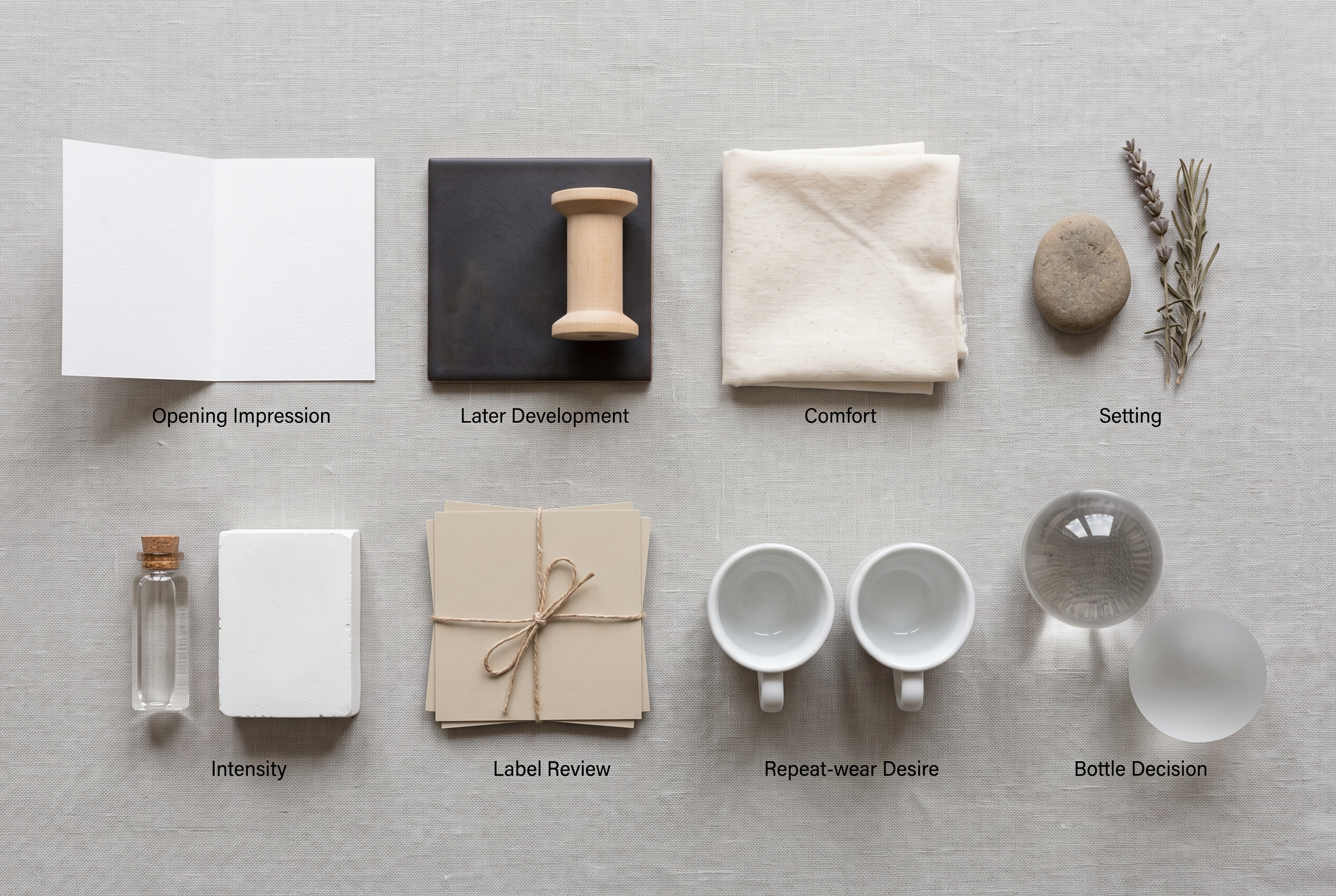
A repeatable scorecard makes memory less influential and helps separate a striking first spray from a fragrance you will actually wear.
| Criterion | What to record |
|---|---|
| Opening | Your first impression without forcing yourself to name notes |
| Development | What changes after the opening and what remains later |
| Comfort | Whether you enjoy it at the amount directed and in your setting |
| Fit | The real outfits, seasons or occasions where you would choose it |
| Distinctiveness | What separates it from fragrances you already own or ignore |
| Label check | Directions, warnings and ingredient information you need to know |
| Repeat desire | Whether you voluntarily choose it again on another day |
| Purchase fit | Current format, price and return terms after live-page verification |
Use words rather than invented precision. The strongest signal is repeat desire: after the novelty fades, do you still want to wear it? If two scents remain close, choose the one that fills a clearer role or continue with smaller formats rather than forcing a full-bottle decision.
Ask these questions before buying feminine perfume
- Which scent direction best matches the impression and setting I described?
- What are the prominent notes or accords according to the current product page?
- What product format and amount am I purchasing?
- Where can I review the current ingredients, directions and warnings?
- Is a sample or discovery format currently available for these finalists?
- What are the current shipping, return and opened-product terms?
- How should the product be stored according to its directions?
- Whom should I contact if the live page does not answer an ingredient or order question?
Auremie's current contact page invites questions about scent advice and orders. Give the team your brief, the products you are comparing and the exact information you need. Treat advice as a shortlist aid, not a guarantee of personal preference or performance.
Feminine perfume shopping red flags
- A universal promise that a perfume suits every woman or every occasion
- An exact wear-time or compliment guarantee presented as certain for you
- Gendered marketing used instead of an understandable scent description
- Therapeutic, allergy-free or safety claims without appropriate evidence
- A concentration label treated as a complete measure of quality
- Pressure to buy a full bottle before reading current terms or testing
- Product details copied from a third-party listing instead of the live label or seller
A bold description can be part of fragrance storytelling. The red flag appears when the story replaces the factual information and testing you need to make a decision.
Common perfume selection mistakes to avoid
- Choosing by the “for women” label without translating your taste
- Testing too many scents in one session
- Judging only the first spray and ignoring the later development
- Assuming a favourite note guarantees a favourite composition
- Using someone else's wear time as a promise for your experience
- Ignoring product directions, warnings and known sensitivities
- Blind-buying because a bottle or campaign looks beautiful
- Keeping a finalist that you admire but never choose to wear
Frequently asked questions
Which notes make a perfume feminine?
No technical list determines femininity. Florals, fruits, vanilla and musk are often marketed that way, but woods, aromatics, leather, citrus and spice can also fit your idea. Choose by the finished scent and your preference.
Should I test perfume on paper or skin?
Paper helps narrow multiple options without layering them on your body. Skin can show how a finalist develops for you when used as directed. Use both stages when possible and safe for your circumstances.
Does eau de parfum always last longer?
Not as a universal rule. Concentration terminology, formula, application, environment and individual perception all matter. Treat the label as product information, not an exact duration guarantee.
How many perfumes should I compare at once?
Use a small enough group that you can still distinguish and document them. If everything begins to blur, stop and continue another day rather than forcing a winner.
Choose a shortlist you will genuinely wear
Write your one-sentence brief, browse Auremie's current women's fragrance collection, and shortlist by scent direction rather than name alone. Verify every finalist's live details, test when possible, and keep a repeat-wear scorecard. If you need help narrowing the list, use Auremie's current contact route and confirm the product, format, label information, availability and purchase terms before ordering.