

How to Find a Perfume Based on Notes With Less Guesswork
Short answer: do not search for a perfume from one favourite note alone. Build a short profile with notes you enjoy, notes you avoid, the fragrance family, the setting, desired presence and two scents you already like or dislike. Use that profile to shortlist samples, then compare the opening, middle and dry-down on separate wear tests before choosing a bottle.
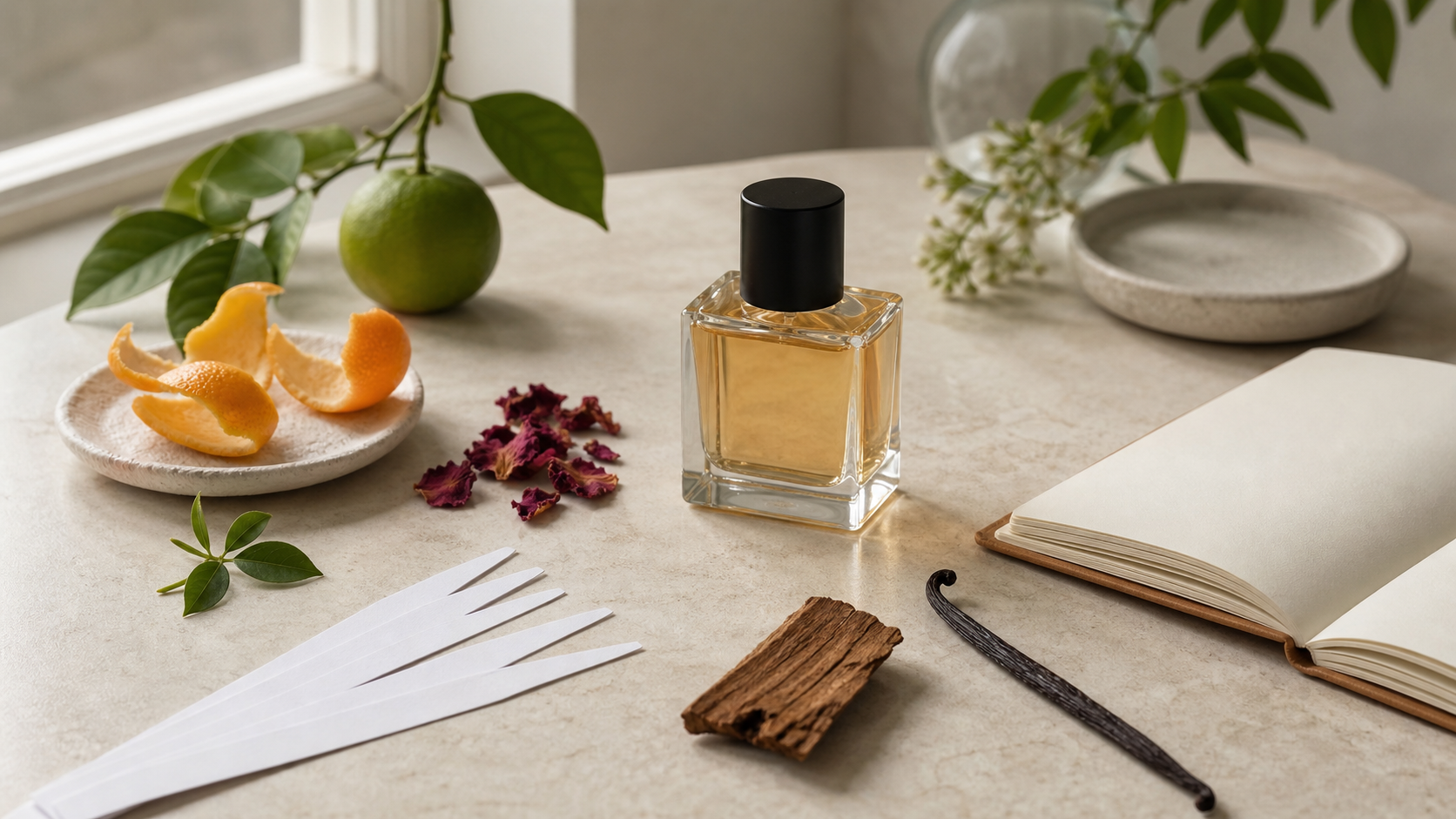
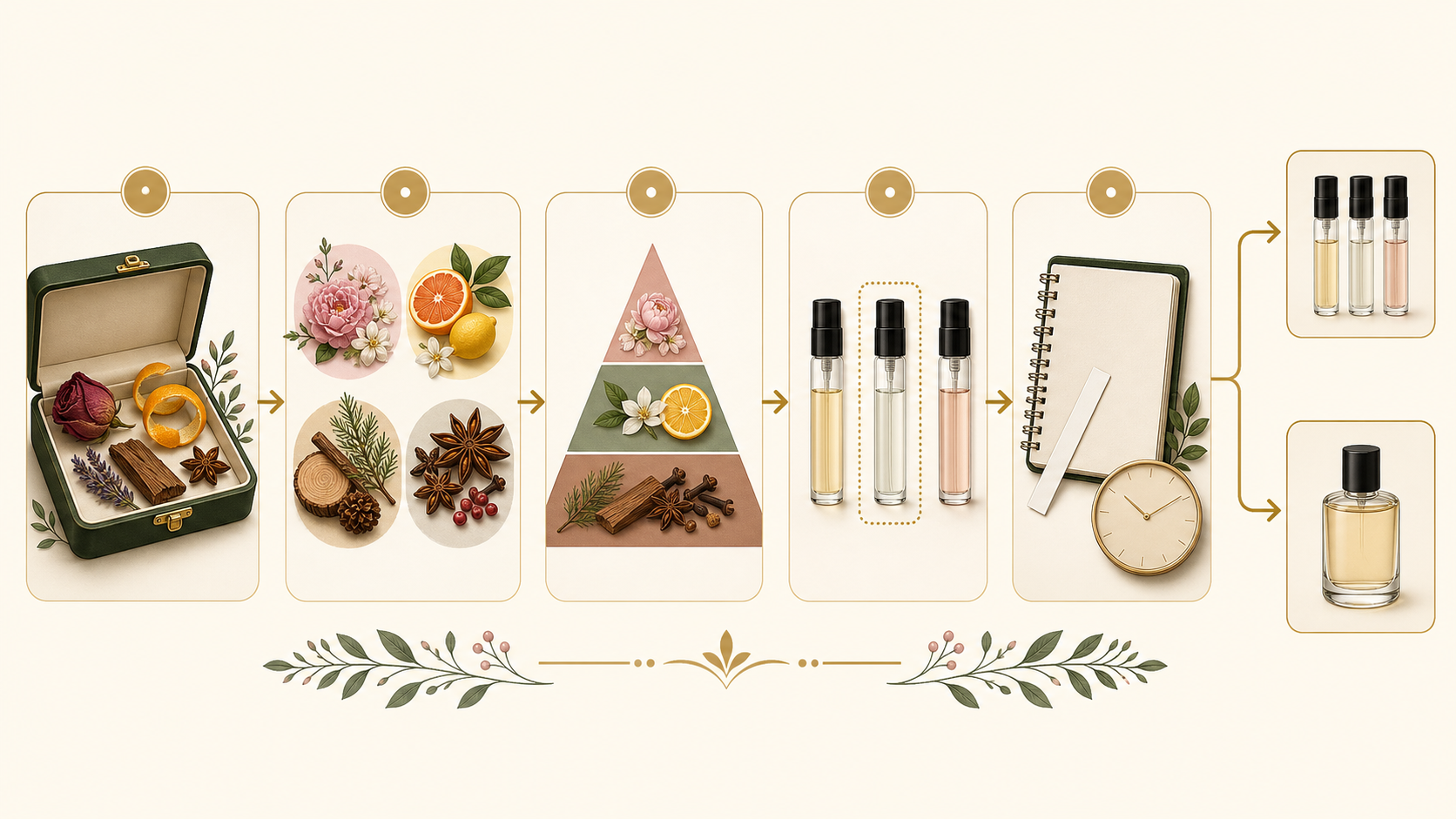
A five-step note-matching method
- Name two scent memories you want and two you do not.
- Translate them into likely note families and contrasts.
- Read the whole note structure, not just the headline note.
- Shortlist a small, varied sample set.
- Wear, log and compare before buying full size.
How the note-matching method works
Finding a fragrance by notes works best as a narrowing method, not a promise. Start with ordinary scent memories, translate them into likely families and contrasts, inspect the whole composition, and then test a small number of candidates. Auremie provides a live Find Your Scent tool for shoppers who want a guided starting point, while this explainer shows how to evaluate the resulting shortlist.
The goal is to make the next decision smaller and more informed. A note match earns a sample or closer look; it does not prove how a fragrance will smell on a particular person, how strongly it will project, or how long any stage will last.
What a note list can and cannot tell you
A note list is a description of how a fragrance is intended to read. A note may refer to a raw material, a blend of materials or an accord designed to evoke a familiar smell. “Amber,” “leather,” “sea salt” and “clean laundry” do not point to one universal ingredient or experience.
The list can help you identify likely direction and compare compositions. It cannot reliably tell you:
- exact strength or distance from the skin;
- how long a stage will last on you;
- whether a sweet note will feel edible, dark or airy;
- how the formula interacts with your skin, climate and application;
- whether two perfumes with similar notes will smell alike;
- whether you will enjoy the full dry-down.
Use notes to decide what to test, not as proof that a bottle will suit you.
Step 1: build a scent profile in ordinary language
Begin with smells, places and products you already know. Write:
- two aromas you seek, such as peeled citrus, dry cedar, black tea or soft vanilla;
- two you avoid, such as powdery cosmetics, syrupy fruit or sharp smoke;
- the setting—work, daily casual, evening, formal event or outdoor use;
- desired presence—close, moderate or noticeable;
- season or temperature where you expect to wear it;
- two fragrances you like and what part you like;
- two you dislike and when they became unpleasant.
“I want something fresh” is too broad. “I like tart citrus and green herbs, but not sugary fruit or heavy vanilla; I want a moderate office scent” gives a selector useful boundaries.
Step 2: use families to organize the search
| If you enjoy | Families or facets to explore | Contrast to test |
|---|---|---|
| Zest, herbs, crisp air | Citrus, aromatic, green | Dry woods versus soft musk |
| Petals, clean fabric, soft powder | Floral, musky, powdery | Fresh floral versus warm floral |
| Cedar, vetiver, forest floor | Woody, earthy, aromatic | Dry versus resinous woods |
| Vanilla, caramel, coffee | Gourmand, amber, spicy | Airy sweetness versus dense sweetness |
| Incense, resins, warm spice | Amber, balsamic, smoky | Soft skin scent versus bold statement |
| Ocean air, rain, mineral freshness | Aquatic, ozonic, mineral | Salty versus clean-musky |
Industry education from perfume.org on fragrance families and the Fragrance Foundation France family overview shows why families are useful organizing tools rather than a verdict about personal fit.
Families are starting points, not rigid boxes. A woody fragrance can also be citrus-forward, spicy, sweet or smoky. Keep one familiar candidate and one controlled contrast in the sample list so the test teaches you something.
Step 3: read the composition as a relationship
Top, heart and base labels describe a creative and evaporative structure, but the boundaries are not a clock. Ask how the notes work together:
- Does citrus lead into flowers, herbs or woods?
- Does vanilla soften smoke, amplify sweetness or add texture?
- Is musk presented as clean, warm, powdery or animalic?
- Do woods feel dry, creamy, green or resinous?
- Is the named favourite note central or only part of the opening?
If your favourite note appears only in the marketing headline and the rest of the structure is full of disliked facets, the perfume may not be a good candidate. Conversely, a scent without your exact word may recreate the effect through a related accord.
Step 4: create a small sample matrix
Choose a shortlist that varies one dimension at a time. For example:
- a citrus-aromatic scent with dry woods;
- a citrus-aromatic scent with clean musk;
- a greener scent with little sweetness;
- one warm contrast that still avoids the shopper's disliked notes.
Record the product name, concentration as currently listed, note structure, family, desired setting and the reason it earned a sample. Avoid ordering several nearly identical bottles based on the same note pyramid.
Auremie sells fragrances and publishes discovery-oriented guidance. Because product availability, sizes, prices, concentration labels and note descriptions can change, check the current fragrance collection before building a shortlist.
Step 5: test in two stages
Stage A: blotter comparison
Label each strip before spraying, use a consistent application, keep strips separated and smell in short sessions. This helps remove immediate dislikes and compare directions without using multiple scents on the same skin area.
Stage B: skin wear
Wear one serious candidate at a time under normal conditions. Follow current product directions and avoid applying to irritated skin. Check it after the opening has changed, during ordinary activity and later in the wear. Do not force an exact evaluation schedule copied from another person's skin.
Log:
- first impression in three words;
- what becomes more or less noticeable;
- comfort at the chosen application amount;
- fit for the intended setting;
- whether you want to smell it again the next day;
- any irritation or reason to stop use.
A decision scorecard that avoids fake precision
| Question | Yes / maybe / no |
|---|---|
| Do I like the scent after the opening changes? | Record evidence, not a number |
| Does it fit the setting and people nearby? | Consider application and environment |
| Does it avoid my strongest dislike? | Note when the dislike appears |
| Would I choose it over the other samples? | Compare on separate days |
| Would a sample or travel size meet my need? | A full bottle is not always the next step |
| Do I understand current price and return terms? | Verify on the live store |
A simple yes/maybe/no log is more honest than a weighted formula that pretends scent preference is objective.
Three example searches
Fresh but not sporty
Start with citrus, tea, green and dry-wood facets. Avoid assuming every aquatic scent will feel fresh in the desired way. Test one aromatic and one clean-musky contrast.
Warm but not dessert-like
Explore amber, woods, resins, tobacco or spice while limiting prominent caramel and syrupy fruit. Compare a dry resinous option with a soft vanilla-wood option.
Floral but not powdery
Look for green, watery, fruity or transparent floral structures and examine the musk, iris, violet and cosmetic facets in the rest of the description. Test on skin because “clean” and “powdery” are personal readings.
Build a personal note dictionary
Product descriptions often use different words for overlapping effects. Save the terms that repeatedly match your experience. If you enjoy “dry woods,” note whether cedar, vetiver, pencil shavings, smoke or mineral descriptions worked. If “clean musk” sometimes becomes laundry-like or powdery on you, record the exact product and surrounding notes.
A useful dictionary has three columns:
- Words that usually work: terms that earned positive wear tests.
- Words that need context: notes that can be enjoyable or unpleasant depending on the blend.
- Words that usually fail: descriptions linked to repeated dislikes.
This is more reliable than copying a universal chart because it is built from your own comparisons.
Use notes differently when choosing a gift
For a gift, do not infer preference from age, gender or one perfume seen on a shelf. Ask about aromas, settings and disliked facets, or choose a discovery format that lets the recipient decide. Verify current return and hygiene rules before buying. A note-based shortlist can make a gift thoughtful, but it cannot remove the recipient's personal test.
Common note-shopping mistakes
- Searching from one note and ignoring the rest of the structure.
- Treating top, heart and base as fixed universal time windows.
- Buying several near-duplicates before testing.
- Judging only the first spray.
- Testing many fragrances on skin at once.
- Confusing concentration label with a guaranteed performance level.
- Using online popularity as evidence of personal fit.
- Ignoring setting, application and people nearby.
- Recording compliments but not personal comfort.
- Freezing temporary prices or inventory in an evergreen guide.
Finding perfume by notes questions
Can two perfumes with the same notes smell different?
Yes. Materials, proportions, accords and the rest of the composition change the result. Note lists are simplified descriptions.
Should I choose from top notes?
No. The opening matters, but evaluate the later scent because that is what you will wear for more of the experience.
What if I do not know note names?
Start with familiar smells and places. A useful selector can translate “dry pencil shavings” or “orange peel, not candy” into families and facets.
Is a discovery set better than blind buying?
It provides a lower-commitment way to compare on your own skin, but check current contents and terms and avoid assuming every set fits your preferences.
How many samples should I compare?
Use a small number you can test separately and remember. The goal is learning, not collecting the largest possible tray.